
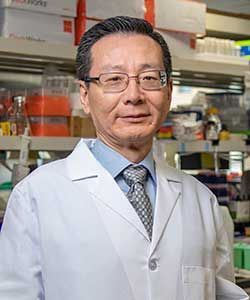
As Department Chair, I welcome you to the Department of Biochemistry and Molecular Medicine’s homepage. We are a basic science department with a lustrous history of academic excellence in research and education. Our overarching goals are to elucidate molecular mechanisms underlying health and disease-related biological processes through innovative and collaborative research, to educate medical, undergraduate, and graduate students in the areas of biochemistry, molecular genetics, genomics, and Bioinformatics, and to train future generations of leading scientists who possess critical thinking and analytical skills.
As the Department celebrates its centennial anniversary, we are profoundly proud of the exceptional scientific accomplishments of our past and current faculty and their research teams. To name just a few:Dr. Vincent du Vigneaud, a former department chair, received the 1955 Nobel Prize in Chemistry for the first synthesis of oxytocin. Dr. Allan L. Goldstein, a former department chair, co-discovered (with Abraham White) the thymosins, a family of hormone-like peptides that play important roles in the immune system, the neuroendocrine system, and the brain. Dr. Ferid Murad, a former faculty member, received the 1998 Nobel Prize in Physiology/Medicine for his pioneering work on nitric oxide. Dr. Edward Seto, currently Associate Director for Basic Sciences at the George Washington Cancer Center, is internationally renowned for his pioneering work on the roles of histone deacetylases in epigenetic regulation. The bioinformatics-driven research team led by Dr. Raja Mazumdar is at the forefront of developing data-analysis tools, community standards for bioinformatics communication, and knowledgebases in glycoinformatics, cancer research, and microbiome analysis. Ongoing research in the Department is generously supported by the Catherine B. McCormick Endowment, which augments research activities and provides bioinformatics support. Please see our Department History, Bioinformatics Core, and individual faculty and laboratory pages for additional information on our research programs.
Built on our past accomplishments and the current research expertise in the Department, we are eager to expand our programs and achieve greater cross-pollination and scientific synergy among the existing research themes both within and beyond the Department. The Department is housed in the same research building as the other basic science departments at the SMHS, including the Department of Anatomy & Cell Biology, the Department of Pharmacology and Physiology, and the Department of Microbiology, Immunology & Tropical Medicine. This physical proximity, combined with the highly collegial culture of the local research community, has provided a tremendous impetus to interdepartmental collaborations and programmatic development. In addition, our institution’s proximity to the NIH, Children’s National Health System, and other institutions in the Washington, DC metropolitan area provides outstanding opportunities for collaboration. Additional opportunities exist to collaborate with colleagues in the George Washington University Cancer Center. Finally, the recruitment of new faculty in recent years, including Drs. Brett Shook, Jiyoung Lee, and Luis Rodriguez, will complement our existing scientific strengths and further enhance the integrated role of the Department in addressing major health and disease-related challenges through innovative, multidisciplinary research.
Closely integrated with our research endeavors is our longstanding educational mission and commitment to training the next generation of leading scientists. Our PhD program is an integral component of the Institute of Biomedical Sciences(IBS) at the School of Medicine and Health Sciences. In addition, the Department-based MS program in Bioinformatics and Molecular Biochemistry provides an excellent training venue that meets the rapidly growing needs of biomedical research, particularly in the areas of data science and artificial intelligence. Our Department also offers strong and comprehensive coursework in Undergraduate Biochemistry, which provides foundational knowledge and a caring and intellectually stimulating learning environment for students aspiring to careers in medicine and biomedical research. I invite you to learn more about our education programs and training opportunities at the undergraduate, MS, PhD, and postdoctoral levels.
Our Department and the George Washington University School of Medicine and Health Sciences are located in the heart of Washington, DC. It is one of the most vibrant parts of the city, with convenient public transportation (Metro and bus stops are located immediately outside our laboratory building) and an unparalleled cultural and historical ambiance. The International Monetary Fund and the World Bank are located on the GW campus, and the White House and the Kennedy Center for the Performing Arts are just blocks away. Both geographically and culturally, our Department is centrally and ideally positioned to improve health through innovative research and to foster scientific progress at the local, national, and global levels. Please do not hesitate to contact us with any questions, comments, or suggestions.
Rong Li
Chair & Professor
