|
|
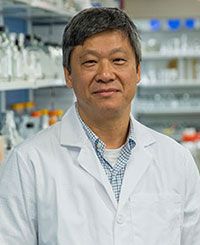
Rong Li
Chair, Department of Biochemistry & Molecular Medicine
Ross Professor of Basic Science Research
Professor
- Research Interest:
-
Breast cancer susceptibility gene BRCA1; Tumor microenvironment; mechanisms of anti-cancer therapies.
Lab Website: https://lilab.smhs.gwu.edu/publications
Office Location: Ross Hall 433
Email: rli69 [at] gwu [dot] edu (rli69[at]gwu[dot]edu)
|
|
|
Romina Araya
Assistant Research Professor
- Research Interest:
-
In the Li Lab, my work focuses on understanding how disruptions to the gut microbiota shape the response to anti‑cancer therapies in breast cancer. Through preclinicalmouse models, I examine therapy‑induced changes in tumor and systemic immunity and characterize shifts in gut microbiota composition and function. I also investigate how clinically relevant antibiotic exposures modify these interactions and contribute to
therapeutic resistance.
Lab Website: https://lilab.smhs.gwu.edu
Office location: Ross Hall, Rm 434
Email: romina [dot] araya [at] gwu [dot] edu (romina[dot]araya[at]gwu[dot]edu)
|
|
|
Jorge Azpurua
Assistant Research Professor
- Teaching Focus:
-
Dr Jorge Azpurua is an Assistant Research Professor in the Department of Biochemistry and Molecular Medicine, School of Medicine and Health Sciences at The George Washington University. Dr. Azpurua received his Ph.D. degree from the University of Rochester focusing on mechanisms of cancer and aging, ad completed his post-doctoral training at neuroscience and aging laboratories in UT Health San Antonio and Stony Brook University.
Teaching:
-
BIOC 3261(Director)- Introduction to Medical Biochemistry.
-
BIOC 3262 (Director)- Biochemistry Laboratory.
-
BIOC 6228(Lecturer)- Research Essentials and Biosciences Careers.
-
PA 6109(Lecturer)- Foundations of Medicine.
Office location: Ross Hall, Rm 434
Email: azpurua [at] gwu [dot] edu (azpurua[at]gwu[dot]edu)
|
|
|
Huai-Chin Chiang
Assistant Research Professor
- Research Interest:
-
The research efforts at the Li lab focus on understanding the interplay between tumor cells, the extracellular matrix, and various stromal components, including immune cells and adipocytes, during breast cancer progression. My specific research focus in the Li lab centers on investigating the clinically important breast tumor suppressor gene BRCA1 and elucidating the crosstalk between anti-tumor immunity and BRCA1-associated cancer biology.
Lab Website: https://lilab.smhs.gwu.edu
Office location: Ross Hall, Rm 434
Email: chiangh [at] gwu [dot] edu (chiangh[at]gwu[dot]edu)
|
|
|
Manjari Dimri
Associate Professor
- Teaching Focus:
-
Manjari Dimri, MD is a nationally recognized educator committed to advancing biomedical education. Her recognition reflects multiple institutional teaching awards, sustained leadership of foundational science curricula, and scholarship in education research. With a background as a physician-scientist, her work is dedicated to advancing biomedical education. She designs and leads learning experiences across medical, school, allied health, graduate, post-baccalaureate, and undergraduate programs, emphasizing integration of foundational science with clinical application. Her teaching focus centers on making foundational biomedical sciences clear, clinically relevant, and intellectually engaging. She emphasizes concept-driven learning over memorization, helping students connect biochemical mechanisms to patient care, research applications, and real-world health challenges. Through active learning strategies, case-based integration, and structured learning objectives, she fosters critical thinking and long-term retention. She is particularly committed to inclusive teaching practices, creating psychologically safe learning environments where diverse learners can thrive and develop confidence in the biomedical sciences.
Office Ph: 202.994.7271
Office location: Ross Hall 517
Email: mdimri [at] gwu [dot] edu (mdimri[at]gwu[dot]edu)
|
|
|
- Research Interest:
-
At the Horvath Lab, We develop computational methods to analyze genetic and regulatory variation at single-cell resolution. Using short- and long-read single-cell RNA sequencing, we quantify expressed mutations, isoform diversity, and allele-specific expression to reveal coordinated, state-dependent regulatory programs within individual cells. We build software platforms-including scExecute, scReadCounts, and scSNViz and develop isoform- and variant-aware machine learning models that link genetic variation to cellular identity, evolution, and therapeutic response. Our work provides a systems-level framework for understanding tumor heterogeneity and advancing precision medicine.
Lab Website: https://horvathlab.smhs.gwu.edu
Office location: Ross Hall 731B
Email:horvatha [at] gwu [dot] edu (horvatha[at]gwu[dot]edu)
|
|
|
Robel Kahsay
Associate Research Professor
- Research Interest:
-
The Mazumder Research Group develops high-performance computational tools for bioinformatics research and communication. The group builds and maintains the HIVE platform in collaboration with the FDA and develops standards for bioinformatics communication through BioCompute Objects. Its work also includes the creation and curation of knowledge bases for glycoinformatics (GlyGen), cancer research (BiomarkerKB, OncoMX, BioMuta, BioXpress), and microbiome analysis. The group leverages knowledge graphs and machine learning and artificial intelligence technologies, including large language models, to harmonize, map, and extract insights from clinical data, omics datasets, knowledgebases, and scientific publications.
Lab Website: https://hivelab.smhs.gwu.edu
Office location: Ross Hall, Room 540
Email: rykahsay [at] gwu [dot] edu (rykahsay[at]gwu[dot]edu)
|
|
|
Jiyoung Lee
Associate Professor
Co-Director of Cancer Biology PhD Program, Integrated Biomedical Sciences
- Research Interest:
-
Cancer metastasis and metabolism, Molecular signaling of breast and head and neck cancer. Lab Website: https://leelab.smhs.gwu.eduOffice location: Ross Hall 437A Email: jiyounglee [at] gwu [dot] edu (jiyounglee[at]gwu[dot]edu)
|
|
|
Zhuqing Li
Assistant Research Professor
- Research Interest:
-
Our lab investigates the molecular mechanisms that drive genome instability in cancer and explores new strategies for targeted therapy. We focus on how key proteins, such as AND-1, regulate DNA replication and repair, particularly at common fragile sites and R-loop regions, and how these processes contribute to tumor development and therapy resistance. Using a combination of mouse models, patient-derived organoids, and advanced molecular and genomic techniques, we aim to uncover vulnerabilities in cancer cells that can be exploited for novel treatments.
Office location: SEH R8480
Email: zhuqing_li [at] gwu [dot] edu
|
|
|
- Research Interest:
-
The Mazumder Research Group develops high-performance computational tools for bioinformatics research and communication. The group builds and maintains the HIVE platform in collaboration with the FDA and develops standards for bioinformatics communication through BioCompute Objects. Its work also includes the creation and curation of knowledge bases for glycoinformatics (GlyGen), cancer research (BiomarkerKB, OncoMX, BioMuta, BioXpress), and microbiome analysis. The group leverages knowledge graphs and machine learning and artificial intelligence technologies, including large language models, to harmonize, map, and extract insights from clinical data, omics datasets, knowledgebases, and scientific publications.
Lab Website: https://hivelab.smhs.gwu.edu/
Email: mazumder [at] gwu [dot] edu (mazumder[at]gwu[dot]edu)
Office location: Ross Hall, Room 431
|
|
|
Patrick McNeely
Assistant Research Professor
- Research Interest:
-
The Mazumder Research Group develops high-performance computational tools for bioinformatics research and communication. The group builds and maintains the HIVE platform in collaboration with the FDA and develops standards for bioinformatics communication through BioCompute Objects. Its work also includes the creation and curation of knowledge bases for glycoinformatics (GlyGen), cancer research (BiomarkerKB, OncoMX, BioMuta, BioXpress), and microbiome analysis. The group leverages knowledge graphs and machine learning and artificial intelligence technologies, including large language models, to harmonize, map, and extract insights from clinical data, omics datasets, knowledgebases, and scientific publications.
Lab Website: https://hivelab.smhs.gwu.edu
Office location: Ross Hall, Room 540
Email: pmcneely [at] gwu [dot] edu (pmcneely[at]gwu[dot]edu)
|
|
|
Luis Rodriguez
Assistant Professor
- Research Interest:
-
The lab has a deep interest in understanding the fundamental biology that underlies the pulmonary wound response throughout our lifespan. We ask this question using mouse injury models, innovative in-vitro models, primary human samples, and through collaborations across the country with labs that have unique and complementary models of injury. Our focus starts with the alveolar epithelium as the site of gas exchange and a point of vulnerability for recurring injury. We also consider a number of factors such as intrinsic epithelial dysfunction, external stressors, and aging, which may disrupt the normal wound healing process. Modeling these factors in our murine models allows us to capitalize on powerful genetic tools developed to study lung disease. We then perform careful reductionist biology using our in-vitro models to interrogate mechanisms. Finally, we take the hypotheses and mechanisms generated in our models and test them in human-derived systems, including organoid platforms or collaboratively with groups that have complementary human models such as precision cut lung slices or induced pluripotent stem cell-derived epithelial cells. Our goal is to help understand the pathology that occurs in human pulmonary disease to identify new therapeutic targets for acute lung injury and chronic pulmonary disease.
Lab Website: https://rodriguezlab.smhs.gwu.edu
Office location: Ross Hall 447
Email: luis [dot] rodriguez [at] email [dot] gwu [dot] edu (luis[dot]rodriguez[at]email[dot]gwu[dot]edu)
|
|
|
Edward Seto
Professor
Associate Director for Basic Sciences, GW Cancer Center
King Fahd Professor of Cancer Biology
- Research Interest:
-
The Seto Lab has a long-standing interest in gene regulation and histone deacetylases (HDACs). Early on, we discovered and cloned HDAC2 and HDAC3 enzymes and performed detailed analyses of these proteins. Over the last 25 years, we have been actively studying many different aspects of histone deacetylation, including the dissection of all 18 human HDACs. Our work has led to seminal discoveries regarding regulation of histone deacetylation and identification of key non-histone targets of the HDAC enzymes. More recently, our work has extended to the analysis of how the activities/functions of histone acetyltransferases (HATs) and HDACs are interrelated, elucidating the role of HDACs in anti-tumor immunity, and identifying HDAC-specific inhibitors for disease treatments.
Lab Website: https://setolab.smhs.gwu.edu
Office location: SEH 8800
Email: seto [at] gwu [dot] edu (seto[at]gwu[dot]edu)
|
|
|
Brett Shook
Associate Professor
- Research Interest:
-
Altered immune responses are central to tissue dysfunction and impaired healing. The Shook Lab combines modern wet- and dry-lab technologies to investigate mechanisms that regulate the immune response during skin wound healing. In particular, we are interested in cellular communication between stromal and immune cells. By investigating the intersection of inflammation and tissue repair using animal and human models, we aim to give translational value to basic science discoveries.
Lab Website: https://shooklab.smhs.gwu.edu
Office location: Ross Hall 437A
Email: brettshook [at] gwu [dot] edu (brettshook[at]gwu[dot]edu)
|
|
|
Ray-Chang Wu
Professor
- Research Interest:
-
My reseach focuses on understanding the biological functions of transcriptional co-regulators AT-rich interaction protein 4B (ARID4B, also known as retinoblastoma binding protein 1-like 1, RBPL1). Using integrative, synergistic approaches, novel conditional Arid4b knockout and ARID4B knockin mouse models and other genetically modified mouse models, the objective and long-term goal of my research program are to: (1) dissect the emerging oncogenic function of ARID4B in the development and progression of breast and prostate cancers, (2) conform the role of ARID4B in therapy resistance, (3) elucidate the underlying molecular mechanism by which ARID4B drives cancer development ad progression to therapy resistance, (4) validate ARID4B pathway is a new therapeutic target in cancers, and (5) develop the first-in-class small molecule inhibitors of the ARID4B pathway toward pharmacological inhibition of ARID4B for treatment of cancers. Identification of ARID4B as a new component critical oncogenic signaling, coupled with comprehensive understanding into its functional mechanism, and development of the first-in-class ARID4B inhibitors will pave the way for better treatment for cancers. Our study has the potential to revolutionize treatment of cancers, impact treatment outcomes and the lives of cancer patients.
Lab location: Ross Hall 556
Office Location: Ross Hall 542
Lab Website: https://smhs.gwu.edu/faculty-research/ray-chang-wu-phd
Email: rwu [at] email [dot] gwu [dot] edu (rwu[at]email[dot]gwu[dot]edu)
|
|
|
Penghua Yang
Assistant Research Professor
- Research Interest:
-
Lab Website: https://lilab.smhs.gwu.edu
Email: p [dot] yang [at] email [dot] gwu [dot] edu (p[dot]yang[at]email[dot]gwu[dot]edu)
Office location: SEH R8480
|
|
|
Wenge Zhu
Professor
- Research Interest:
-
The Zhu lab focuses on DNA replication and DNA repair mechanisms, anti-cancer drug resistance, and therapeutic drug discovery across multiple cancer types, including breast, ovarian, skin, and colon cancers
Lab Website: https://zhulab.smhs.gwu.edu
Office location: SEH Suite 8870
Email: wz6812 [at] gwu [dot] edu (wz6812[at]gwu[dot]edu)
|